
|
Revenue Analyses:
Income Tax Analyses:
Numbers — Charts:
| Tweet | | Contact | Follow @chrischantrill |

What is the US Income Tax Revenue?
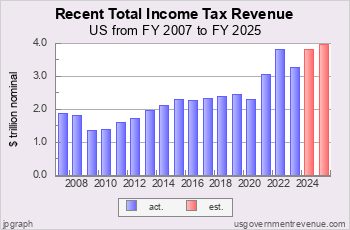
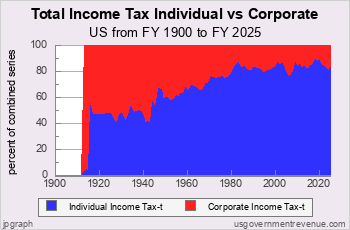
In FY 2026, total US income tax revenue — federal, state and local — was $4,060 billion according to the Office of Management and Budget report of federal revenue and usgovernmentrevenue.com’s “guesstimate” of state income taxes. Individual income taxes collected $3,465 billion and corporate income taxes collected $595 billion.
Estimated total income tax revenue — federal, state and local — for FY 2027 is $4,118 billion.
Total US Income Tax Analysis
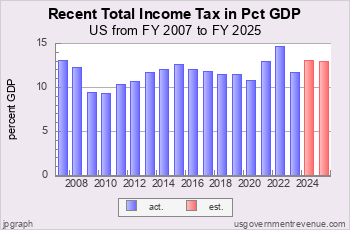
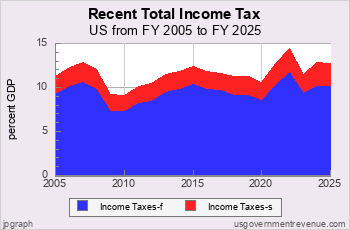
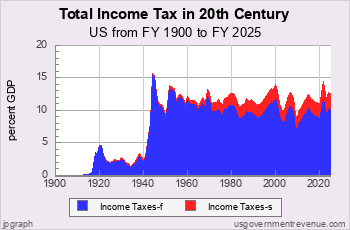
This page shows the current trends in US National Income Tax revenue. There are also charts on US National Income Tax revenue history.
Recent US Total Income Tax Revenue
Revenue Analyses:
Income Tax Analyses:
Numbers — Charts:

Suggested Video: All About Income Tax
Top Revenue Requests:
Find DEFICIT stats and history.
US BUDGET overview and pie chart.
Find NATIONAL DEBT today.
DOWNLOAD revenue data.
See FEDERAL BUDGET breakdown and estimated vs. actual.
Check INCOME TAX details and history.
See BAR CHARTS of revenue.
Check STATE revenue: CA NY TX FL and compare.
See REVENUE ANALYSIS briefing.
See REVENUE HISTORY briefing.
Take a COURSE at Taxes 101.
Make your own CUSTOM CHART.
Revenue Data Sources
Revenue data is from official government sources.
- Federal revenue data since 1962 comes from the president’s budget.
- All other revenue data comes from the US Census Bureau.
Gross Domestic Product data comes from US Bureau of Economic Analysis and measuringworth.com.
Detailed table of revenue data sources here.
Federal revenue data begins in 1792.
State and local revenue data begins in 1820.
State and local revenue data for individual states begins in 1957.


Site Search
Spending 101
Take a course in government spending:
Spending |
Federal Debt |
Revenue
Defense |
Welfare |
Healthcare |
Education
Debt History |
Entitlements |
Deficits
State Spending |
State Taxes |
State Debt
It’s free!
Win Cash for Bugs
File a valid bug report and get a $5 Amazon Gift Certificate.
Get the Books
 Price: $0.99 Or download for free. |
 From usgovernment spending.com Price: $1.99 |
 Life after liberalism Price: $0.99 Or download for free. |
Data Sources for 2015_2031:
Sources for 2015:
GDP, GO: GDP, GO Sources
Federal: Fed. Budget: Hist. Tables 3.2, 5.1, 7.1
State and Local: State and Local Gov. Finances
Sources for 2031:
GDP, GO: GDP, GO Sources
Federal: Fed. Budget: Hist. Tables 3.2, 5.1, 7.1
State and Local: State and Local Gov. Finances
'Guesstimated' by projecting the latest change in reported spending forward to future years
> data sources for other years
> data update schedule.
Blog
US Budget Deficit, Receipts, Outlays for FY 2026
On October 15, 2026, the US Treasury reported in its Monthly Treasury Statement (and xlsx) for September that the federal deficit for FY 2025 ending September 30, 2026, was $1,99 billion. Here are the numbers, including total receipts, total outlays, and deficit compared with the numbers projected in the FY 2026 federal budget published in February 2025:
| Federal Finances FY 2026 Outcomes | |||
|---|---|---|---|
| Budget billions | Outcome billions | ||
| Receipts | $5,873 | $5,403 | |
| Outlays | $7,419 | $7,396 | |
| Deficit | $1,547 | $1,993 | |
The Monthly Treasury Statement includes "Table 4: Receipts of the United States Government, September 2026 and Other Periods." This table of receipts by source is used for usgovernmentspending.com to post details of federal receipt actuals for FY 2025. usdgovernmentspending.com obtains the data for outlays and receipts from apis at fiscaldata.treasury.gov.
This MTS report on FY 2026 actuals is a problem for usgovernmentspending.com because this site uses Historical Table 3.2--Outlays by Function and Subfunction from the Budget of the United States as its basic source for federal subfunction outlays. But the Monthly Treasury Statement only includes "Table 9. Summary of Receipts by Source, and Outlays by Function of the U.S. Government, September 2025 and Other Periods". Subfunction amounts don't get reported until the FY28 budget in February 2027. Until then usgovernmentspending.com estimates actual outlays by "subfunction" for FY 2026 by factoring subfunction budgeted amounts for FY26 by the ratio between relevant actual and budgeted "function" amounts where actual outlays by subfunction cannot be gleaned from the Monthly Treasury Statement.
On August 7, 2026 we updated the state and local spending and revenue for FY 2024 using the new Census Bureau ...
On July 2, 2026 we updated the state and local spending and revenue for FY 2024 using the new Census Bureau S ...
> blog
